Waiting for April
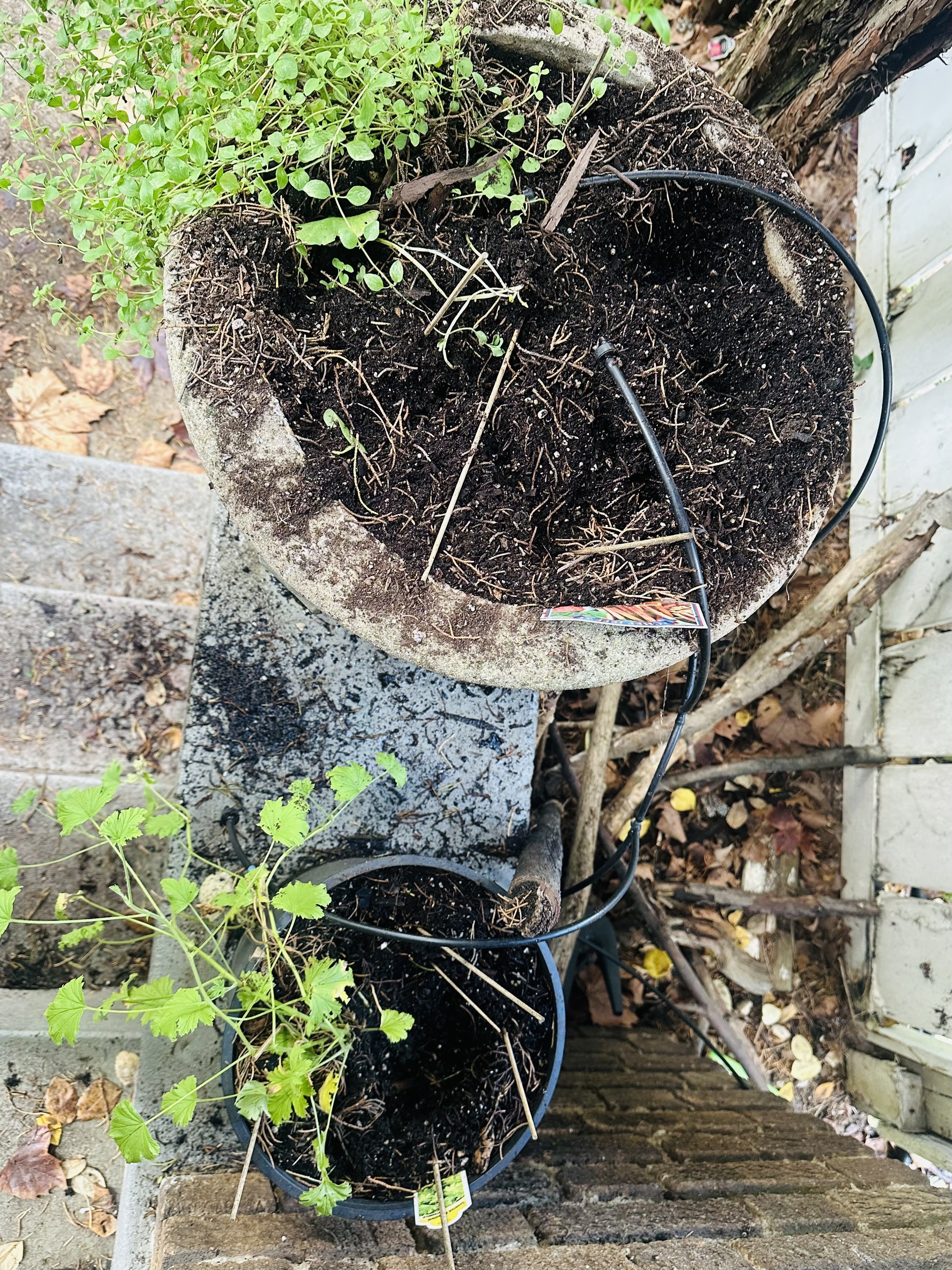
“What are you doing here?” I am not speaking to my son, who plays outside as I perform the regular ritual of sweeping the detritus that collects on our front porch, the overflow from recent digging by resident squirrels. I am talking to a plant.
The stone planter on our front steps was once home to a squat almost-tree, briefly stately when freshly planted by former owners in their bid to sell us the house. In time it grew gangly, awkwardly outgrew the planter like a newly-sprouted teenager. We sawed it off and reclaimed the space for flowers, herbs, the summer’s basil already cut down in anticipation of the coming cold. Now something new is growing.
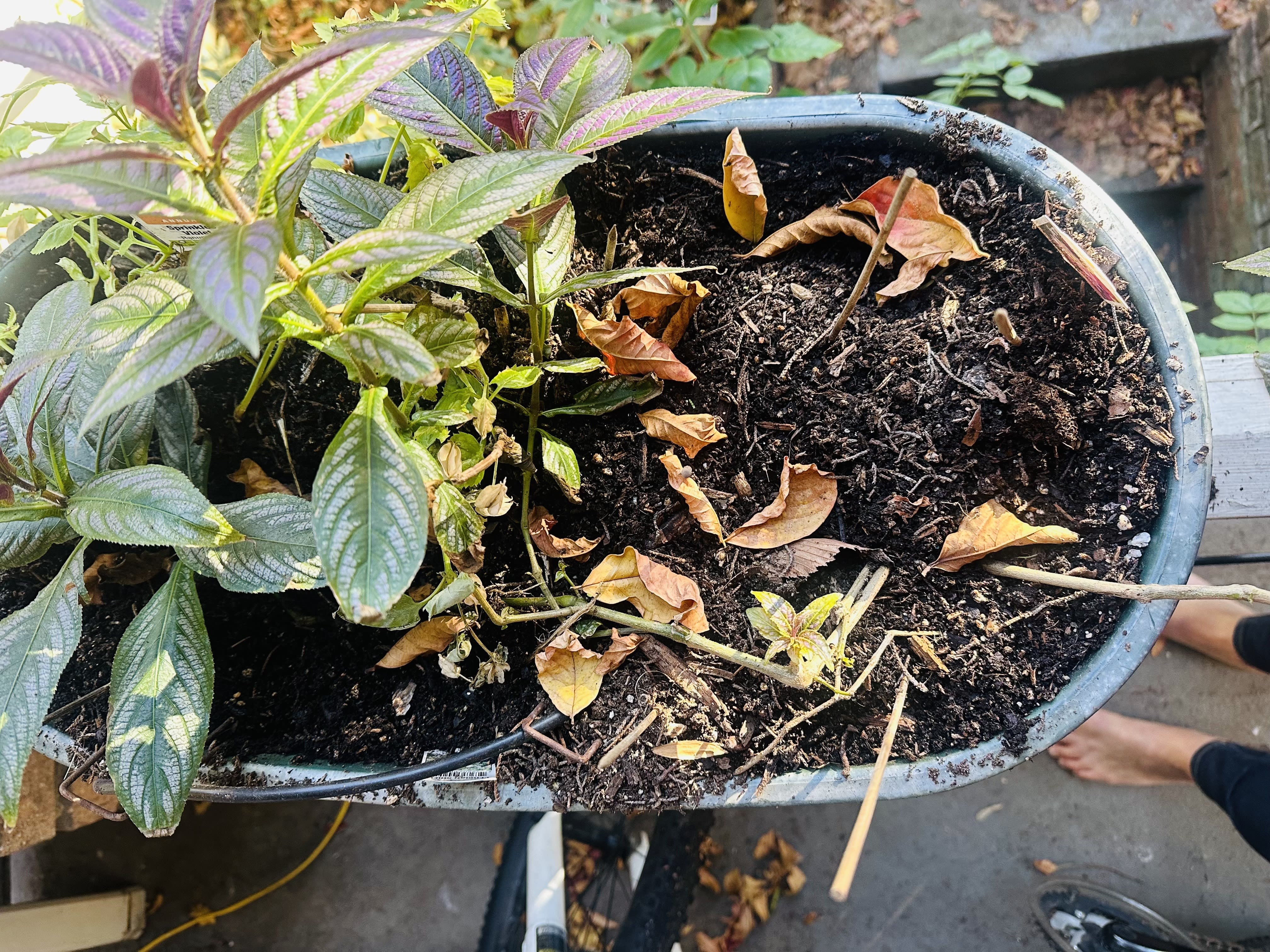
“What is it?” my son asks, pleasing me with his curiosity. I show him the result of the pillaging squirrels, the spilled dirt I’m sweeping, the golf-ball sized holes where it used to be. Midway through the summer my kids concocted a plan to keep the greedy squirrels out of the flower-filled planter boxes perched on our porch railing, poking wooden chopsticks upright at intervals in the planters to discourage digging, like drunkenly constructed fence posts. Has this had any impact? We declined to A/B test. For a few weeks the squirrels seemed to stay at bay, but now, again, the holes, the dirt.
“Look,” I point out, showing him the plant, a volunteer snaking out of the stone planter, a cucumber or squash, with its tell-tale twin rounded proto-leaves. It’s already unfurled the first two true leaves, which, if given time at the right temperature, would expand into a whole rope of a plant. Early October, it might even succeed in forcing out the beginnings of a flower, just in time to be killed by a November freeze, no shot at reproducing. An evolutionary failure. It would have been better for the plant, I explain to my son, if it had waited in the dark as a seed, held off on trying to emerge until the warmth signaled not a final shot of a false summery feeling before true cold, but the real emergence of elongated days building toward a long heat. What a waste.
As long as it remained a tightly packed seed, this plant had years of potential, primed to seek its fortune at any opportune time. It just needed to be patient in the dark. Having germinated, this plant cannot be salvaged. Soon, it will die, last of its line. I can only admire, briefly, it’s fresh smooth green, contrast to the sharp-edged crackled leaves of fall, before it does.
My son listens to me bemoan the doomed plant’s timing, echoes my disapproving cluck cluck and comments, “it grew at just the right time.”
“It’s actually the opposite,” I begin to point out but he stops me.
“Mom, I meant it in the sarcastic sense, like it grew at the wrong time.”
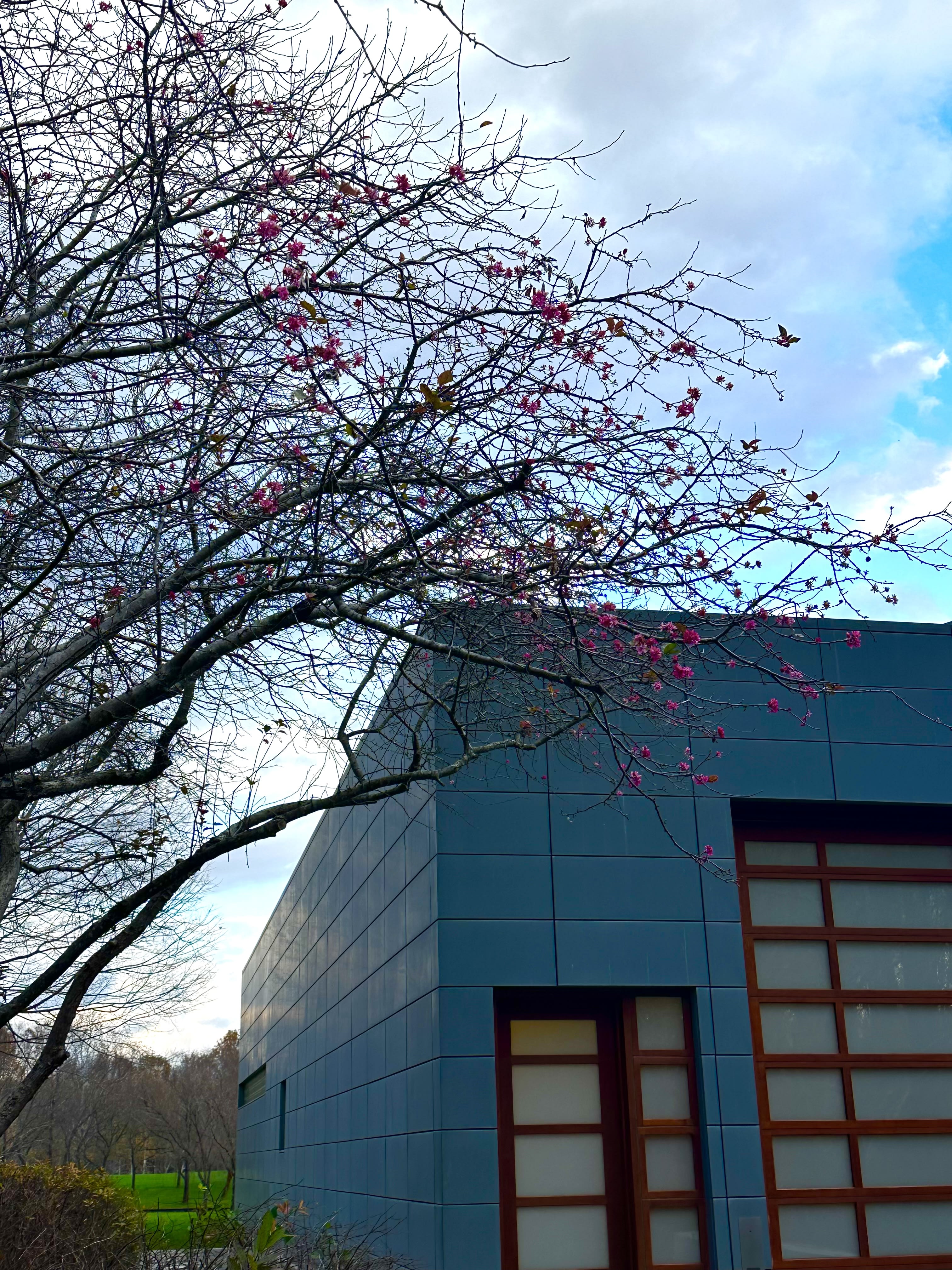
My own image of fall-blooming cherries at Glenstone, in Potomac, MD.
This long warmth, extending through mid-November, is toying with all kinds of plants. A friend snaps a photo of a fall blossoming cherry tree in the Cathedral gardens. Should we be concerned? There has already been, apparently, just enough cold intermingled with our long, languid fall to induce in this tree and its brethren the annual leaf drop, prod them into the usual dormancy, where they should rest all winter. Cherries, like many plants, require a designated amount of cold to be goaded into flowering come spring—they need to accumulate a certain amount of time under temperature, vernalization, we call it—vernal, Latin for of spring. Are the margins really so fine that when warm weather sneaks back in after the cold snap, the dormant tree, like my volunteer, could be tricked into shocking its buds back to life? Does this untimely plumage bode poorly for spring blooms? I research the phenomenon and find gardeners assuring fall blossom is no death knoll for the spring show. The tree can regather and bud afresh, they promise. Nature is resilient. I want to bookmark this tree and return in March to see for myself whether the delicate wisp of a flower that is the cherry blossom—mediocre in isolation, but cumulatively stunning, not unlike autumn leaves—unfurls as gloriously as hoped.
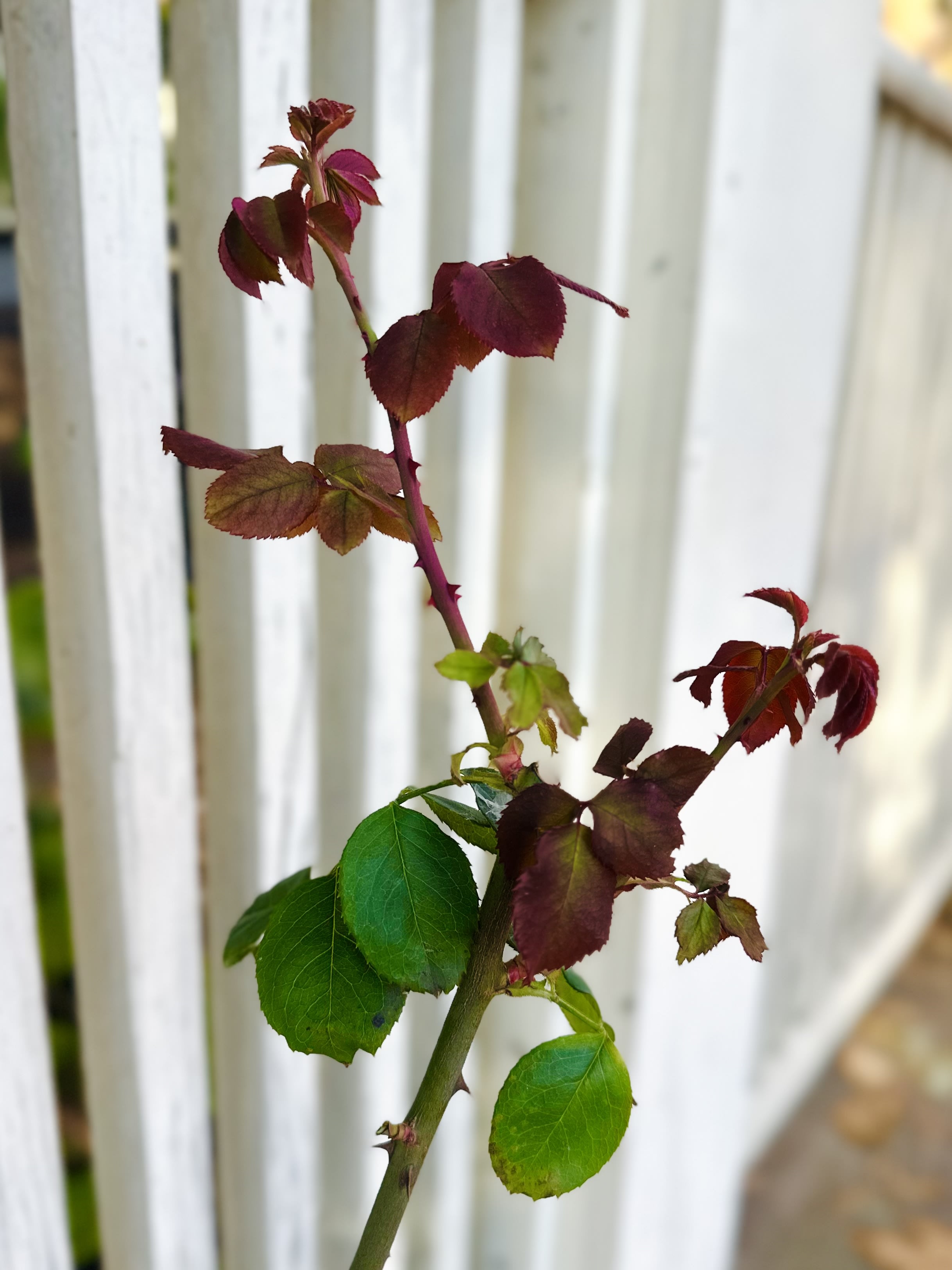
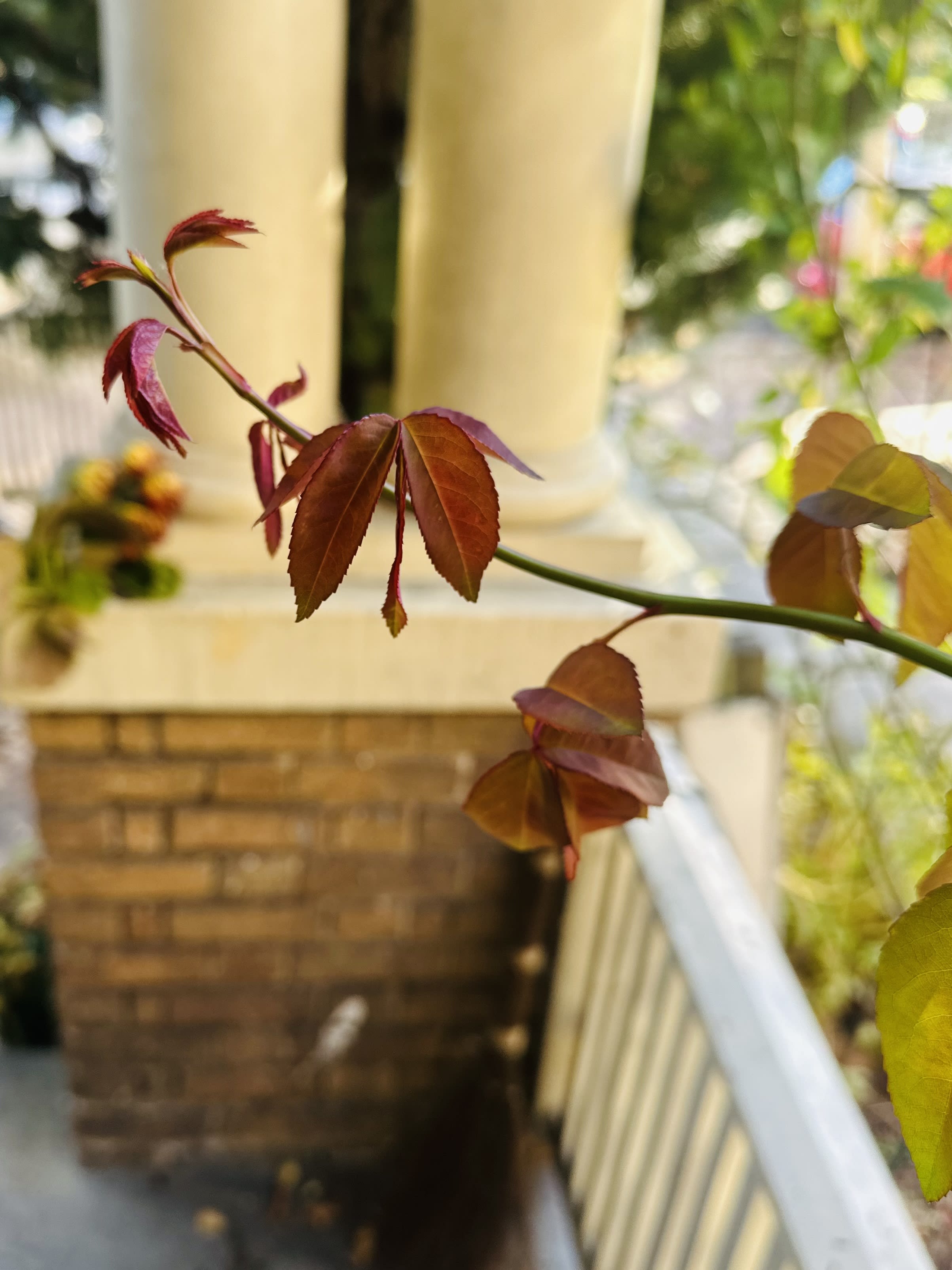
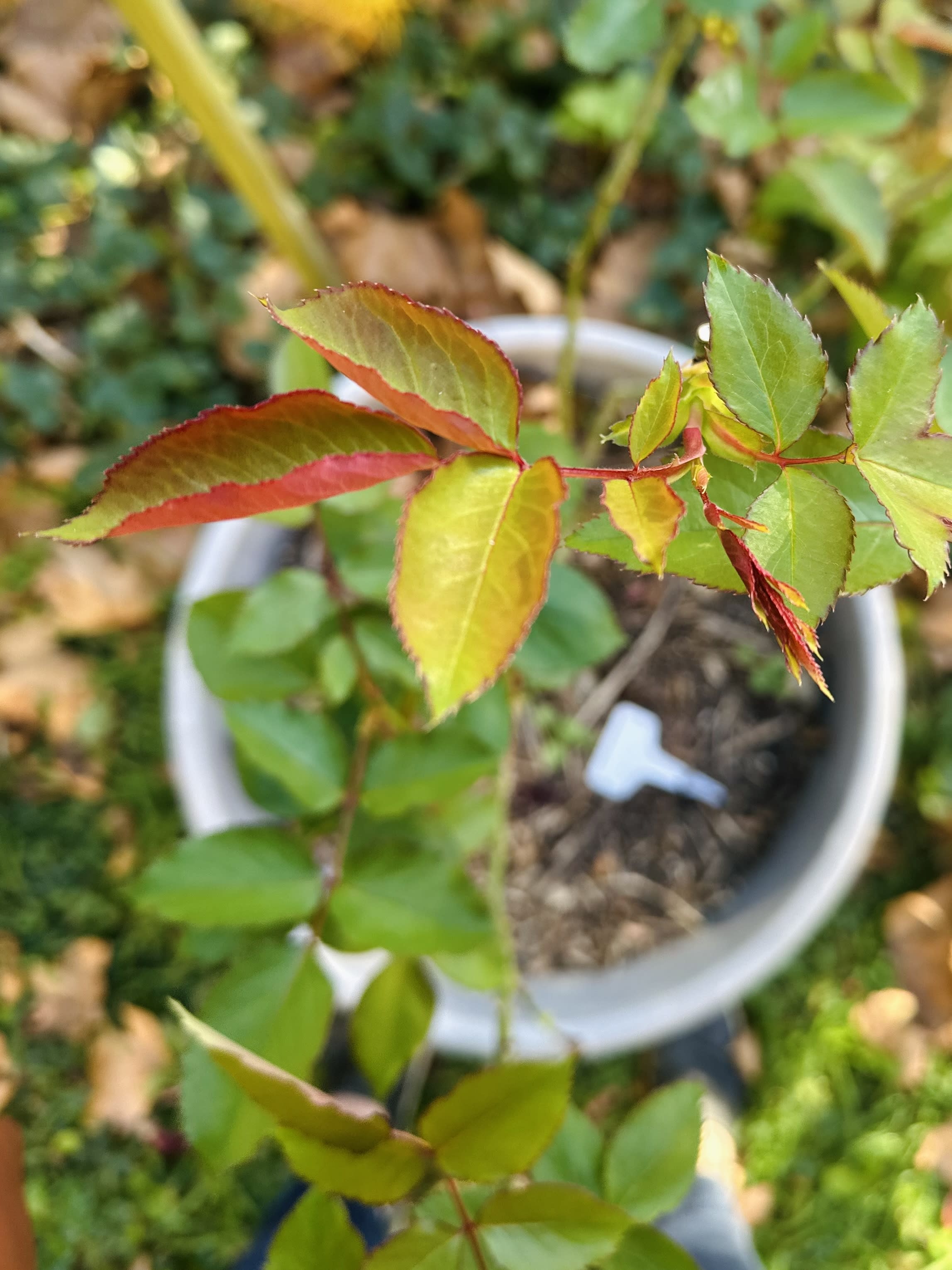
A few inches of mulberry-hued shoots protrude from my front yard rose bushes, like they do in April, extending the plant outward when it should be hunkering down. Should I worry about all that energy directed into upward expansion at the expense of more deeply burrowing its roots?
Really, I shouldn’t be growing roses here at all, this sliver of my dense urban neighborhood yard, shaded with old trees, lacking the requisite hours of sun. My mother-in-law, a true rose afficcionado, has observed as much, and when I see her glorious, densely-blooming bushes under a wide-open July sky, the contrast between my own meager, stunted bushes proves the point. But I love them. So I grow them anyway, apply crushed eggshells and liquid fish poop, babying them in bad conditions and coaxing out a few stunning bouquets that beat the odds before the trees leaf out in May, and the roses lose their sun. All summer they search for light, placing their bets on single towering canes that soon exceed the strength of their root systems and droop dangerously toward pedestrians. But then in October the papery brown leaves of the nearby sycamore drop, followed by the soft yellow of the crepe myrtle, sprinkling our front walkway with flames, and suddenly the sun whooshes in again, brighter on the understory than it’s been in months. The roses are ready. The calendar does not say bloom, but conditions do, and they seize the opportunity to try.
Fall is the ripe time for roots. November soil here remains warm, may not freeze through til January. Spring soil, in contrast, retains residual chill, remains compact and impenetrable long after the sun-kissed surface warms. You’d think spring would be planting season, all those luxuriously warm days ahead, but no, it’s fall—what a new shrub needs most is root structure, and you plant when the site of the most important growth is most amenable. (This is something I know experientially, through attempts to move a shovel in earth. But to be sure, I fact-checked myself, pulled a chart of typical ground freeze dates in Farmers’ Almanac. It listed every state, but not the place I live, Washington, DC, a microcosm of what it means to be this kind of Washingtonian.)
In fall you’re technically supposed to stop deadheading and fertilizing. Both adding nutrients and removing spent plant matter have a similar effect on a rose bush: wind in the sails. Both prompt the plant to grow, grow, grow, trigger the kinds of fresh shoots I see emerging here. It’s dangerous, stoking this frost-vulnerable growth so late, delaying the plant’s rootward focus. I don’t care. I deadhead ruthlessly, trimming each opening bud at a 45-degree angle, above a five-leaf cluster, to decorate my desk. I want to goad it to keep going while the light is good, like a coach whistling out sprints at the end of practice. Again! Again! Our late frosts make success plausible, and unlike the squashling in my planter, these root systems are established, can afford this risk. Even after cold air halts the progression of surface growth, their roots will continue tunneling.
But the wasted squash, bound soon to die, provokes anxiety. I mourn the plant’s misguided, unfruitful efforts. It waited so long, worked so hard to germinate and emerge. It must have been so proud to break the surface at last. Until sensing, too soon, harsh winter winds when it expected inviting spring rain. What disappointment, what despair it must feel. Yes, I am anthropomorphizing a squash seedling.
Maybe it’s a little much for a plant. But aren’t we all that squash?
Waiting is hard.
Waiting without knowing where we are in the story is harder still. For most of what matters we lack the convenience of a cyclical calendar to orient ourselves; we must grope in dark discernment. Is it a spring, time for blossom and bud, preparing to unfurl? Or fall—time to shed, pause, hunker down? What if, like the cherry blossoms, we experience a false bloom, out of time with a deeper reality? Or what if the calendar suggests hibernation, but everything within us, and without as best we can perceive, sings to bloom anyway, like the brave November roses seizing the rush of sun when the leaves finally fall?
In practical terms: Is it prudent to hold the emotions close and let the relationship simmer a while, or brave to make a bold statement of affection? Do we wisely postpone the dream of grad school til kids are grown, or are we wasting time we should spend reaching for the stars? Is it faithfulness to patiently stick it out at the job or a leap of faith to leave without an answer?
Because waiting is hard, because we do not know if there will be a more opportune time, because we may wonder if we, like that volunteer squash, are an accident, on our own, no one working for growth on our behalf, we’re prone to take matters into our own hands, like Adam and Eve in the old story. They pluck the plant off-limits; we are the plants, often unwilling to be tended in a Gardener’s time. We’re prone to push to make something happen that may not yet be ripe, force our little green heads through any crack toward a growth that conditions cannot yet support.
What if we got our way, on our terms? What if our prayers were answered, but too soon? What if we received exactly what we longed for exactly when we wanted it, but it was out of season—the warm breeze we took for spring was but a balmy fall day? Without knowing when we are, how do we know if what we want is good? Sometimes we ought not prematurely nudge new growth. Sometimes remaining in hibernation until the climate warms is wise. Evelyn Underhill (in The House of the Soul) sings the virtue of fortitude, the “inconspicuous heroism that sits tight.” And in life with God, she advises, “there is a great deal of sitting tight; of refusing to be frightened out of it or decoyed away from it; of refusing to despair, waiting until the weather improves … We must endure a mysterious pressure, which operates more often and more purely in darkness than in light …” When our valiant attempts make little headway, our surrounding conditions are inhospitable, perhaps we sit tight, take heart that we may be reserving our strength to wait for April.
Yet, sometimes in our dark discernment we sense an opening, pour our reserves into a mighty, worthy try—and stall. Not because we pushed where we should have waited, but because we made our best call with what we knew. That’s not failure. That’s not death. That’s not sin. It’s bravely living the reality of a different kind of economy: where roots run deep, where there is enough, where life is regenerative, you can afford to risk. Underhill adds, “The soul that plays for safety, even spiritual safety, never becomes perfect.”
Yes, little squash, sprouting out of time, last of your line, your hopeful start will abruptly sputter out when winter falls. But even this is no cause for despair. My squash anxiety is the currency of a scarcity economy. But as W. David O. Taylor describes, (in his chapter on Surplus in his recent work on the arts To Set the World Aflame) God’s economy is one of abundance. The plant turns back into soil, enriching the base from which springs the next new life. The seed is not one solitary opportunity but one of many, there remain plenty of chances to germinate at the right time. Excess abounds: my childhood backyard dotted with rotting fallen apples, unconsumed; unseen wildflowers that did not need to grow; billions of seeds scattered that will never germinate. In God’s economy there will always be more than enough. We can survive a false start. We can afford a frost-killed bloom.
What about you?
Reflection: Do you sense what season you are in? As you grope in dark discernment, are there places you sense an invitation to wait? To go for it? How free do you feel to risk a false start or a frost-killed bloom?
Practice: Recall an experience of trying something, and feeling like the time wasn’t right. What happened? What does it feel like now as you remember it?