They Won’t KNOW!
The purring weatherman voice on the Lyft’s radio won’t stop hyping this perfect June evening, like it’s a present he personally wrapped up for us. “Low 80s, no humidity, enjoy it folks!”
Just before the early dinner I’ve prepared, my daughter makes a smoothie. She’s seen me make hundreds, a go-to snack or dessert when pantries run low, sneaky pipeline of plant matter to my pickiest child. At seven, she’s already stretching toward independence, making for herself and her younger sister the specialty she calls “mushed beans” from the canned black beans she requests in bulk, responsible enough to earn money through diligent chores, count the bills in her fanny pack weighted down with sparkly keychains, and improvise a way to get to the corner store where she’s not quite old enough to go alone: “I’ll buy you a Coke if you walk with me,” she calls to her big brother. The gimmick is effective and the deal is solid, the two dollars mattering to her less than the opportunity to feel grown-up.
Her smoothie lacks the measuring and recipes I rely on for smoothies, unlike most of my slapdash cooking, where I’m competent enough to pull off improvisation—I tweak recipes even while baking. With smoothies alone I meticulously make my way through dog-eared, fruit-stained pages of the book I bought on impulse to guide my wayward blender mechanics. Before the book, my smoothie ratios were always off, stubborn frozen matter suspended in swishy solution, and routinely cement colored. So I bought this (accidentally vegan) smoothie cookbook, relying instead of yogurt on dehydrated superfoods I’d never before encountered: lucuma, goji berries. The smoothies fit in categories—hydration, protein—that matter to me less than “children eating plants instead of five granola bars.” Each recipe has a purpose and plan—sneak in frozen cauliflower, say, or taste like a carrot cake. I’ll take my cauliflower undisguised, thanks. But by and large, you couldn’t argue with the result. An honest sub for a milkshake, a shockingly easy way to consume a large salad. For over a decade, I’ve faithfully pulled packets of colored powders from my smoothie box, kept frozen bananas and coconut water ice cubes on hand. I still reach for this book whenever I make a smoothie.
Not my daughter. She opens up the freezer drawer and tips into the blender a generous pour of each kind of fruit we have in stock, target flavor profile simply “I made it myself.” Peaches, cherries, berries, hooray! A swig of lemon juice—why not? A frozen banana, whole. The thing takes ten minutes to blend, my familiar dilemma of frozen chunks swimming in a liquid pool, and while the color is vibrant, the smoothie lacks oopmh. More liquid—orange juice to boost the flavor? A handful of cashews? She keeps tweaking, filling the blender.
When she finishes, there is plenty. Enough for her cup, siblings, parents, refills. But smoothies are like dessert, all that sugar, even natural—so girls, let’s get some food in our bodies. Dinner is ready. Let’s sit down. This early dinner is not a given in our house—why do you think smoothies make such frequent appearances? When I resist my compulsive impulse to eke out work til the last possible moment, it is a triumph of self-discipline, a symphony of the virtues of (a different kind of) family planning. We don’t fall apart waiting for the meal. We don’t make a pre-meal meal—smoothie excepted—to mollify the child-beasts while we wait for the inevitable long simmer or final bake I hadn’t accounted for in my skim of the recipe I only sort of followed. I say this simply to emphasize the importance of the first thing I told you: when I say we had an early dinner, do not take it for granted. This is not a casual description of an ordinary night, but a victory, born of my sacrifice of productivity, an invisible casualty which might cost me sleep or private anxiety, but which permits right now a sense of luxuriously abundant unhurried family time.
We eat. The time is still early, daylight lingers. “Can we go to the playground after dinner?” one child asks.
I feel generous. “OK.” I pause. I still want my smoothie, waiting for me as the dessert I responsibly put off til having eaten my roasted eggplant and pesto pasta. “I just have to get my smoothie cup, I can bring it with me.” I nod to the opaque pink Owala tumbler on the counter.
This last sentence ripples with electricity through my smallest daughter, sending her into a concerned high alert. “Smoothie!!??” she asks, incredulous. “But what if they won’t know what’s in your cup?”
“They?” I repeat, mimicking high school English teacher of old. “Who is they? There is no they.”
Lacking the framework to engage a writing lesson on character development, she frowns up at me. “They is a word,” she says, accusingly.
“Yes, I know honey, they is a word. I mean, they is—what person? Or people? When you say “they won’t know what’s in my cup,” who do you mean?”
“The people at the playground,” she says, as if I am a small child very slowly grasping what the rest of the table well knows.
“Oh. OK. So the other people at the playground. They won’t know what is in my smoothie cup.”
“Yes,” she says, the patient-but-growing-irritated teacher at my plodding dawning of reality.
“That is … correct.” I say, buying some time as I consider what her concern might be. “Why is that important?”
“They won’t know,” she insists.
“Right.” I affirm. “They won’t know. They won’t know what is in your smoothie cup.” At least we are establishing a baseline of fact, more than we can say of much of our current public debate. “But why does that matter?” She looks at me without comprehension, or rather, as if I am without comprehension. I try again. “Honey, why would anyone at the playground care what is in my smoothie cup? Why doesn’t it matter if they know or don’t know what is in it?”
“Be-cause,” she intones, still a grain of patience with my recurring slowness, “they won’t know.”
“Babe, no one is going to pay attention to what is in my smoothie cup. No one cares. I can just drink it, and they won’t know but it doesn’t matter.” She is not persuaded. My husband tries. He gets no different result.
The conversation see-saws between these dual perspectives for some time as I finish my pasta and she perches on the chair next to me, face aghast at the possibility of smoothie non-knowing which I cannot grasp. I do not bring her around to my perspective that, while possibly true, it is of no relevance. She does not succeed in further elucidating her concern.
By the time I finish my pasta I am too full for smoothie. Into a Tupperware it goes, for my daughter to enjoy tomorrow. I savor the lingering flavor of garlic scape pesto, confiding in my husband as we walk out the door to the playground: “My mouth tastes of garlic. Will that keep you from kissing me?”
He grabs my hand, playfully squeezing an answer.
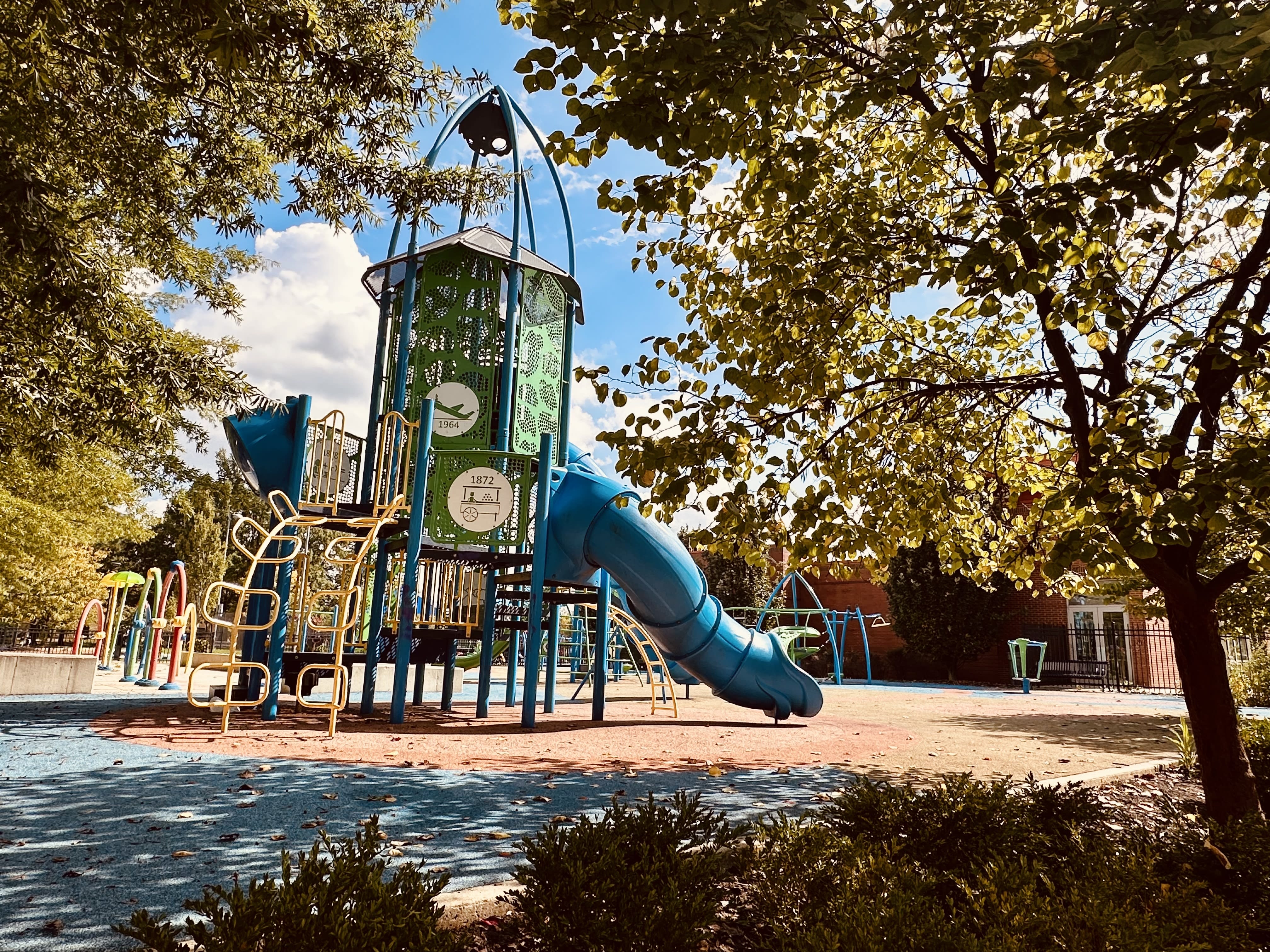
At the playground, they climb—my youngest bold enough now to cross the rope bridge to the slide, something she couldn’t do at the beginning of the school year. A neighbor whose daughter switched schools is here, daughter playing near ours—the kids too shy to quickly resume play as adults catch up, still neighbors even if we no longer share a school. Kids zip between us, happy, in the twilight of the school year, when days are long but not sultry. I keep returning my phone to my pocket, which it keeps trying to slide out of into my hand, so I can watch the climbing, talk to the neighbor. I should have left it at home, and brought the smoothie cup. The weatherman was right. Making dinner early was a triumph. Nor garlic breath, nor school swaps, nor smoothie mysteries, nor our inability to fully understand need keep us from enjoying all this beauty together.
The next day, a stubborn dog refusing to let go of the ball, I ask her again. “Honey, do you remember we were talking about smoothies?” She remembers. “Why,” I ask again, determined to impose some meaning on her insistent, confusing response. “Why did it bother you that people would not know what was in my smoothie cup?”
“Because,” she responds, again patient with the slow child of a mother who cannot grasp what is so clear to her, “some people might not know what is in the smoothie cup.”
“And why is that a problem,” I repeat, addicted, it would seem, to this maddening loop.
“Because some people might like smoothies, but they don’t know,” she explains. What is it like to look at your mother, unable to piece together the most obvious equation even as your five-year-old mind continues to decode it? In the reverse, I would lose patience; I have and I do. She does not seem to attach emotion to my failure to connect the dots, other than slight puzzlement that it is so hard for me to understand.
But here, at last, she’s offered a crumb; the intrepid dog picks up the scent and tracks further. “Wait, so are you worried that people would like a smoothie, but they don’t know it is there, so they might miss out?”
“Yes!” she emphasizes.
I want to be sure. Dig in again: “Do you mean that you like smoothies, you think they are yummy. And you think other people might think they are yummy. And you want to share them. And you’re worried they wouldn’t be able to enjoy them because they don’t know?”
“Yes!” she answers, like I’ve finally won the prize.
It was that simple. Like the beautiful evening itself, smoothies are a delight, and delight is meant to be shared.