Look at the Birds
“Look at the birds of the air!” Birdwatching, you could argue, is a hobby ordained by Jesus, a literal command.
I hear the faint knocking sound against a tree trunk, towering above me but not too distant, and pause. I look, like Jesus instructed. Will I see the woodpecker this time? As usual, I do not. But a robin struts atop a fallen log, making its way in small hops along the surface, red breast puffed out, catching the sun and glinting bright. These creatures are common—easy to spot. Does this mean they are also common—unimpressive, unimportant? Does the fact that there are a half dozen of them trotting through the forest floor on any given day, readily available as the object of my gaze—unlike the mysterious woodpecker—make them less marvelous? Jesus never specified which birds.
Cardinal and jays are common here too, making near daily appearances in the cluster of trees I look out at from my writing desk. That fact aside, the bright glint of red darting through the trees, the cool hush of blue flitting against the brown, never feels less than miraculous. That such shocking pops of primary color should emerge against all this monotonous foliage, it dazzles me every time. On another walk I see three jays on a still-bare tree, each claiming its own branch. I stop and watch them trade places, flying between branches as if seeking an excuse to stretch their wings and showcase their extravagant abundance of blue, the rarest color, bestowing it on me as a privilege. I watch them settle and fold the wings back in, perched proudly above me, as if they are royalty expecting an offering from their common onlooker below.
Another walk, I hear the knock again and as usual, look up in search of the sound. This time, I see a flash of movement. I follow it, cautiously, as if it cannot hear my every movement, sense my presence. I know nothing of the sensory powers of the woodpecker, only conscious that I am the clear intruder in this forest-scape, thundering through in my shoes and artificial smells. Surely none of these birds endure surprise at noticing my presence as I do theirs, materializing as they seem to from thin air, disappearing at will. It’s hard to make out the shape of this bird I’m tracking when it sits still, but it moves again and I am closer this time, can follow it with my eye to another tree, nearer me. I walk up to the tree’s base and gaze up. Now I see: outlined clearly against the rugged brown trunk, the crested head of the pileated woodpecker. A small one, but a sure match to the photos I later google to confirm. It ignores me completely. It gathers itself, then moves back and forth rhythmically, creating that faint knocking sound I’ve heard so often from a distance. Here it is, the very source! Something in me shifts, rejoicing, paralyzed with ecstatic gladness. I’ve found it! I get it! This feeling, the aha, the awe, putting your eyes upon a creature you have heard, heard of, sought and tracked, and then, gloriously beholding, standing in its presence and simply looking at it, an act somehow generating such pleasure—this is it, this is why people bird watch.
How does one become a bird watcher? It seems like a good hobby to take on. Aside from the Son of God urging it on, there’s something vaguely nerdy cool about knowing the difference between all those little brown fluttering things, giving them proper names, about being able to tick off stranger birds you’ve seen, or identifying a bird by its call. I can do little of that now.
I know people who can; a friend of mine is an avid birdwatcher, the real kind. He goes on bird watching trips. He’s given talks on bird watching as a spiritual practice. We are sitting together in a small group, trying to pray, when what sounds to me like a duck’s obnoxious quack shudders through the trees, echoes floating down from high above us, like this water bird has been stranded in the upper branches after a flood. “Fish crow,” he informs us, as each new quack-caw, more like laughter than judgment, filters down through trees to the silence of our circle. “They don’t usually come this far north, but I’ve been seeing them for a few years now, and I think their habitat may have just changed.” “Climate change,” one of us mutters, and we try to keep praying. His knowledge of the bird, its voice, its terrain—that is a bird watcher, right?
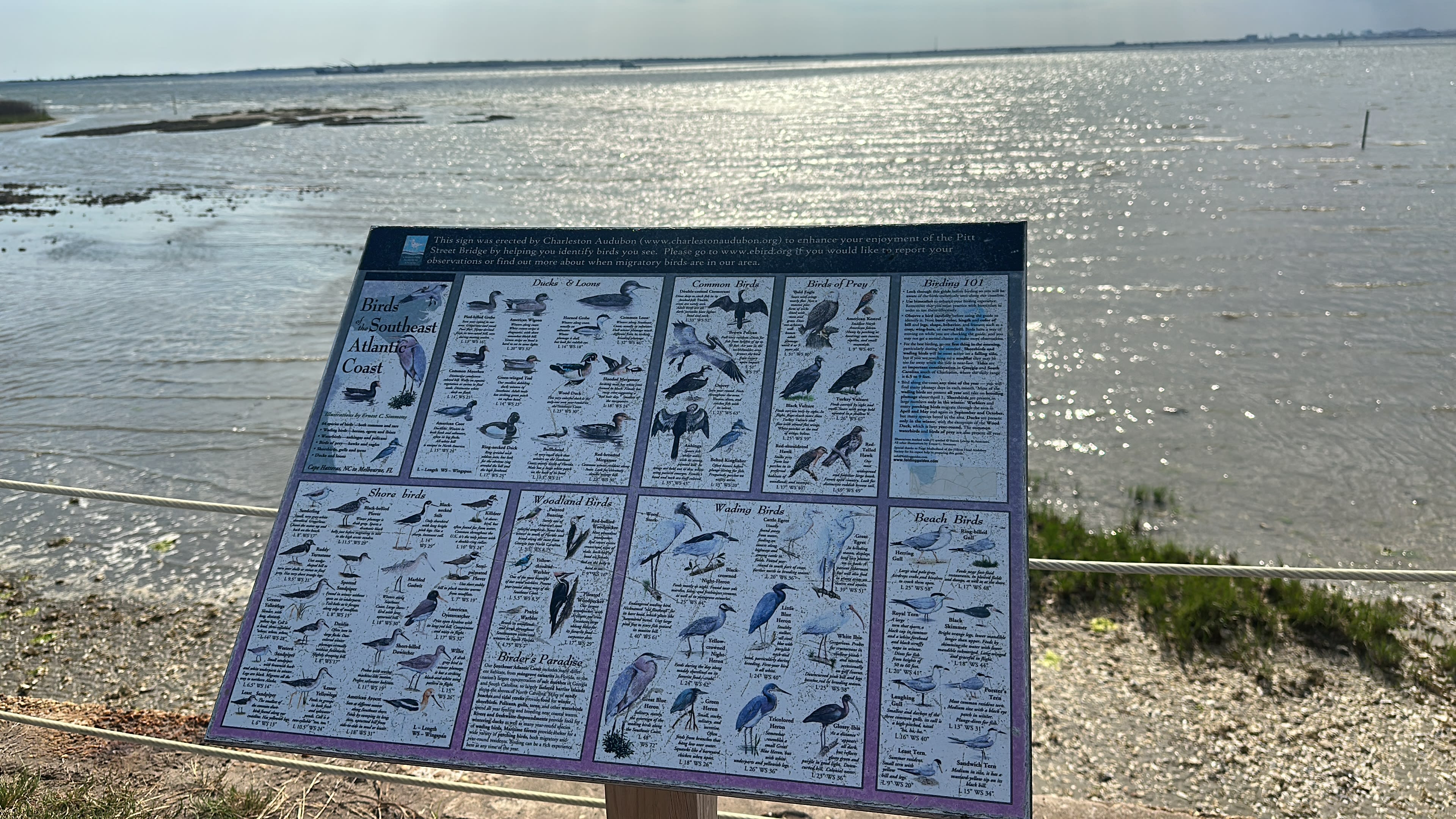
A few days later I am by the water in another state with my children, walking out on a board walk over a marshy tidal flat where mud and reeds and oyster reefs create a wild, stinky habitat for any number of shore birds. Along the boardwalk is an illustration of the local birds and their names. Do I look down, study the picture, memorize the captions? Then perhaps I too could tap a store of facts about these unruly creatures, make notes about their habitat or migration patterns, mentally domesticate them.
Meanwhile my son bikes down the edge of the pier and back, eyes up, following the flight path of different sets of wings, black in relief against the sky, watches them circle, descend, find their footing in the mud. The next day we go to the city, sit on benches in a park by the water; the next day, the beach—and he does the same thing. Eyes up, on the birds. Look at the birds of the air, Jesus said, and my son is doing it. He knows nothing, he captures nothing, there is no domestication or mastery. He just likes looking at them. Is that enough?
Eventually, he asks for a phone to photograph them, to look them up in Merlin. “Birdwatching is just an approved pathway to a screen,” my husband remarks. I disagree. The looking came first. Then the desire to see more closely, to distinguish one set of distant black wings from another. Knowing not for mastery but for awe. Or maybe he just wants a screen. But this pathway from noticing to awe is the one I want to take, and this is a start. We start exploring what we see:
The shiny blue-black bird that looks like a young crow, hopping near our picnic, interested in our scraps, is a boat-tailed grackle. Common, like the robin—there are dozens of them, but stare at any single one and be stunned by the luminescence of those shiny blue-black feathers.
The gull with a white neck and black head who seems to exchange howls of laughter is in fact the laughing gull, whose contrasting colors make it easy to spot at a distance.
In the trees above us two large white birds, heads decked in showy plumage, tangle with each other, playing like monkeys across the canopy. Snowy egrets? Regal in their bouncing feathered crowns, immense wings, pure white, like angels looking down, you feel blessed getting to gaze upon them.
A few days later I’m running along my own wooded creekside path, this precious preserved stretch of forest cutting north south through my city, oasis of water trickling through it. I am trying to resume my running habit, rebuild endurance I haven’t had since before children. I have a plan, and I’m following it, down along this path accumulating miles. Then before me on the creek a wing unfurls, magnificent array of long gray-blue feathers, the single side of a heron paused on a rock in the creek, looking back at me, all power and glory. His wing folds back in and he reverts to the thin line of a statue. I stop, wondering if I can catch another glimpse of that glorious wingspan. He ducks his head into the water, emerges a moment later, his throat bubbles and swells as he swallows. Still he keeps the wings folded. The timer tracking my run creeps upward while my distance remains static. I could stand here all day—or could I? The demands of the day loom over me: getting home, kids to school, making a living, while here stands a heron, unbothered by it all, eating breakfast, refusing to perform on my schedule. I keep watching. He keeps standing still. He has nowhere else to be.
What am I hoping to see as I look at him? That he does not sow or reap or store away in barns and yet his breakfast awaits? But I’m less moved by his food than by his existence. Birds: what a crazy invention of an animal, like a child’s reckless concoction—look ma, it flies!—coloring madly, imagining the impossible soft perfection of an aligned feather. Who wouldn’t want to look at such a thing? So big, so strange, so unimpressed by me. Again, in the bird’s presence it is I who feel common, blessed, to simply see the thing. Looking gives way to awe.
How does one become a bird watcher? Is it that simple: give them your attention? Not reading all the books, knowing all the facts, pursuing the rare ones, crossing continents to check them off your list. Simple as a child, you see birds and you stop running. You postpone your plan. You watch them. Long enough to allow the seeds of awe to germinate and sprout.
A hundred feet down the path, once my run resumes, I see a man with binoculars, gazing out at the creek. Another heron? I see nothing. “Bird watching?” I ask, and he nods. “There’s a big heron on the rocks just down there,” I tell him, and he nods again, but doesn’t leave his post. There’s something he has his own eyes on, invisible to me in the short time I have to look as I keep running.