God is our Parent!
“I asked God to tell Mother Nature to make the people up there stop fighting, and not hurt anyone,” she confides soberly, as I hold her, whispering my own prayers. “Thank you God that our house is strong and dry. Please keep the trees from crashing on anyone, keep our neighbors safe.”
The storm had blown in around midnight, the wall of lightning shimmering through the closed blinds, waking me even before the close-following cracks of thunder split the sky. The next morning people would share dramatic videos of DC landmarks as backdrops to near constant flashing. Gorgeous, right? I’m sure they got a lot of likes. My first thought: to get that footage you’d have had to been outside, how terrifying, no thanks, what were you thinking?
Ensconced in bed, I waited for the inevitable—the door to our room opening slightly, feet padding to my side of the bed, soft body sliding in next to me, familiar nighttime words: “I’m scared, mommy.”
I made room for her, offering the silent calm of my body at rest, my slow breath inviting her to ease with me into a stable rhythm, the smooth murmur of my voice calling her nervous system to release. I marvel at the wild beauty of the lightning, thank God for the protection of our sturdy walls and windows. “Isn’t it wonderful that we have a house that keep us safe and dry? God, please care for anyone who doesn’t have a house like this, please keep them safe.” After a few minutes buried in the covers, she tells me of her own prayer. Mother Nature! She’d returned from summer camp singing about Mother Nature’s love of creation, from the squirrels to the tall trees; does she think Mother Nature is a real person? We’ll sort that out later.
“You did the right thing with your fear,” I assure her, “You came to ask for help and you talked to God about how you were feeling. You knew exactly what to do. That was perfect.” She nestles into me, her body relaxing at last into sleep while I keep watch. When the storm finally subsides, the thunder a distant echo, lightning reduced to mild flashes some minutes apart, I escort her to bed and tuck her in, where she rests easily until morning.
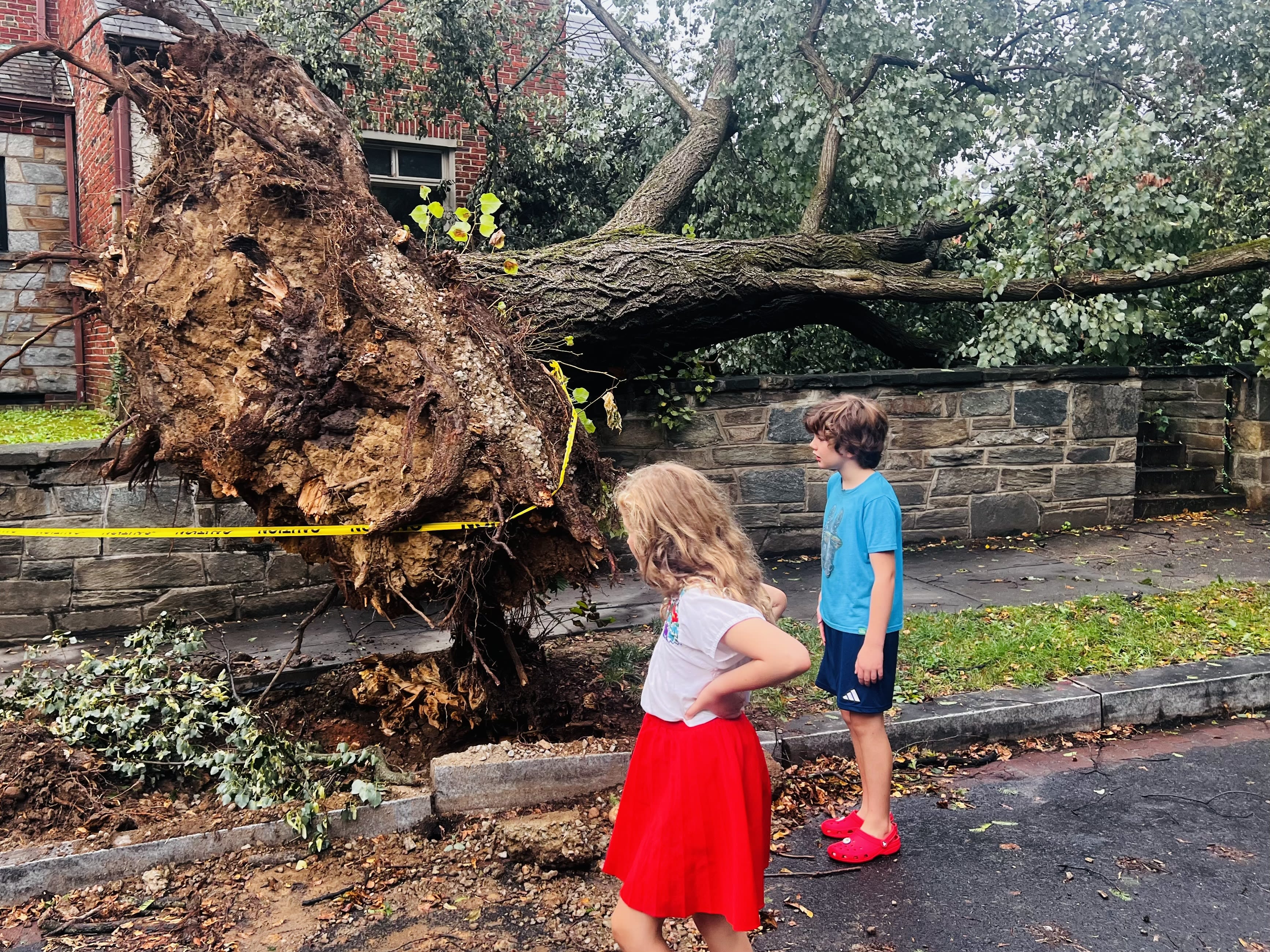
The next day we’re processing the storm. We’ve seen it’s carnage, trees down across the neighborhood. A big one fell at a neighbor’s, perfectly angled to wedge into their oddly-shaped triangle yard and just avoid their house, a miraculous miss. I remember my midnight prayer. “Thank you God for keeping them safe,” I exclaim. She recalls Mother Nature. Can I set the record straight without dislodging the sweetness of her guileless prayer?
“Honey,” gentle, gentle, I urge myself. “Do you know there isn’t an actual being that is Mother Nature? It’s more like … a metaphor. An idea we use to help us talk about and think about nature, how important it is, how it takes care of us and we have to take care of it too. It’s a really beautiful idea. But there’s not an actual creature named Mother Nature.”
“Oh,” she says, considering, her brother listening in. “So … is Mother Nature actually just God?”
“You could think of it that way,” I reply.
“So it’s more like Father Nature,” my son says.
Whoa, whoa. Teaching moment! “Well, is God a man?” I ask, leaning on my law school training, craftily planning to socratic method them into deep waters.
My six year old does not follow the script. “Yes!” she chimes in, perhaps parroting ideas she’s heard directly, more likely her interpretation of Christian doctrine gleaned from church, where baby Jesus is, after all, a boy, and we routinely pray “Our Father,”— or perhaps just a wider cultural image of He-God that has filtered through even our largely secular surroundings.
Red alert! Must intervene!
I could tell them, and I do, that the Bible uses both male and female words to describe God, but God is not a man or a woman or even half and half. Gender for God is a kind of metaphor not so different from Mother Nature. I speak of the Hebrew word for spirit using the feminine. Point out motherly imagery—a hen brooding over her chicks.
I don’t even get into the recurring dilemma of the English language’s lack of pronoun for a living being that isn’t gendered, a quandary for a writer who talks frequently of faith but intentionally resists assigning God a gender; you end up repeating God and all God’s names in awkward but accurate sentences. I don’t tell them of my musing that they/them might be the most accurate English term, not in the plural sense, for the Lord our God is one God—but the more recent sense of encompassing both genders and neither, or beyond human gender entirely, our human categories reflecting but not confining God.
I never know what words sink in, how they might unwittingly distort my meaning—like creating a Mother Nature goddess from a campfire song. Or what hits the as-yet-untilled ground of their young minds, seeds too early to take root.
What I do know: they know—conocer, not saber—the feeling of my mother-body offering my flesh and blood for them. When they hear of Jesus doing that for us might they have a visceral physical memory of what it feels like to receive that?
Not merely (the not-insignificant act of) birth. At best they may realize as adults the perilousness I endured for their sakes but of course they can’t remember. I mean the active, ongoing embodied giving of self that is parenthood: children climbing on my body, grabbing my hand, climbing on my lap; requesting application of a bandaid, inspection of a splinter, wiping up accidents or illness; children scooped up after a sidewalk face plant or friend rejection and sobbing freely in enfolding arms, children clinging in the night. Children routinely demanding more than my human reservoir feels capable of giving. In the times I manage to give freely, it is given as an imitation of, from the excess of, God-love given to me. At my best, I love my children as God loves me, like a mother.
In the raw human physicality of my mother love, limited and flawed as it is, in their clinging to me at midnight as thunder cracks, I pray they know something of God as mother, something my words could never convey.
But here in the kitchen on a Friday morning they have my attempt to explain: “So you see, it’s not Father Nature, or even just God our Father. That’s an image that helps us imagine what God is like, but God is beyond just being one thing—God can be like our mother, too.” The six year old sits on a stool, her mind invisibly processing all I’ve shared, a long pause before she’s ready to spit out the computation.
“So it’s like God is our PARENT,” she concludes, in her sing-song voice.
Not just father, not just mother; the one in whom we live, and move, and have our being. Maybe this is enough theological training for one morning before school. “Yes, honey. God is like our parent.”